Monday, June 25, 2018

New Review: London Town

Writer's Note: No Monster Monday this week, as I wasn't quite able to catch an appropriate film for it this past week- sorry! I should be able to do a Flashback Friday later this week, though, so look for that. I did, however, watch a few movies, of which the subject of this review is one, so there's that.

I also finally sent out that poll to determine which franchise I should review, and the results- so far, at least- are decidedly mixed. Amusingly enough, each of my suggestions either received the same amount of votes or none at all, while my query for people to suggest their own if they weren't included resulted in even more possibilities- all of which only got that one vote each!

So, in summation- there was no clear winner, as I hoped, just a lot of split votes. Go figure. I guess I'll just have to take matters into my own hands. I'll give it a few more days, just in case a tie-breaker emerges, but thus far, it's a completely split vote all the way around. Maybe I'll just do one of the selections that got NO votes. I always was one to pull for the underdog.

Also, I have been working here and there on my next 6-month anniversary list, the one about my fave rising stars. I decided, just to move things along, to limit each list to around 20 names, and I'm up to around eleven or so on the next list, so I should have that for you soon. So, keep an eye out for that, hopefully later this week!

Moving on... here's a look at the recent movie London Town. 


Like a lot of teens, I went through a "punk" phase, and was lucky enough that it happened when there were still a few actual punk bands left standing, though I suppose a lot depends on your definition of the much-debated sub-genre.

I would have to say the "most" punk bands I saw live were The Ramones, Fugazi, Siouxsie & The Banshees and The Cramps, as well as plenty of so-called Grunge bands, though some don't consider that to really be punk. Probably because the bands associated with it don't sound anything alike, really, making it an ill-defined sub-genre at best. Then again, you could say the same thing about the bands I named. 


Up for no debate whatsoever, however, is The Clash, oft-cited as the best punk band ever, or "the only band that matters," as the ads put it. While I lean slightly more towards The Ramones, who are a bit more fun, I certainly love The Clash, and admire the way they weren't afraid to mix politics into their sound, which not all punk rock did, despite its reputation to the contrary.

Certainly they had more to say than, say, The Sex Pistols, who, lest we forget, only put out one official album. The Clash were also much more musically diverse than a lot of punk, mixing everything from reggae to ska to funk to rockabilly to rap into their heady mΓ©lange of "message rock."
As such, their music has aged a lot better than a lot of old-school punk, the much-maligned final album Cut the Crap notwithstanding. 


The film London Town seeks to capture that time period, circa the late 70's, in which young Englanders first embraced the new genre, and the obvious way it divided the population at the time, with the older generation horrified at what they were seeing, given the wild hairstyles and fashion associated with it, to say nothing of the music itself, which was unapologetically loud, brash and oft-controversial lyrically. 

The films focuses in on the 14-year old Shay (Daniel Huttlestone, Into the Woods), who practically runs the household in his poor, lower-class home, almost serving as an ad-hoc wife to his father, who works two jobs and is barely home at any given time. By day, the father sells pianos in a music shop; by night, he drives a cab. Neither are doing him much good at staying afloat financially. 


Things take a turn for the even worse when Nick (Dougray Scott, Mission Impossible 2, Fear the Walking Dead), the father, is seriously injured moving a piano, hospitalizing him indefinitely, leaving Shay to make some tough decisions.

Shay attempts to get a hold of his absentee mother, Sandrine (Natascha McElhone, Californication, Designated Survivor), who lives in London, but is a bit of a drop-out, squatting in various places and taking up with several men at once, all the while trying to further her musical career. 


Eventually, Shay gets her to step up a bit when his little sister, Alice (Anya McKenna-Bruce, Sense8) falls ill, but just barely, and it soon becomes clear he will have to take matters into his own hands, which he does by donning a dress (to look older than he is) and driving his father's cab at night!

Among his fares one night is none other than Joe Strummer, of The Clash, played by Jonathan Rhys Meyers, who he's a huge fan of, and strikes up a bit of a friendship with, eventually even getting to watch the band rehearse at their practice pad. 


Later on, the two even get (dubiously) locked up in jail together, after a riot breaks out at a free show given by the band to smooth over another riot that broke out at the prior one. Presumably this was the "Rock Against Racism" show in Victoria Park, though the movie plays fast and loose with the chronological elements, in terms of what songs were out when and the like, so it's hard to say.

Granted, the story is almost complete fiction, and some of the musical elements/real-life events are used for dramatic effect, but I can see where die-hard fans might be a little dubious of the way the film portrays certain things and the time period in which they happened. But if you can go with it, it's a fun little movie, as unlikely as some of it is, in terms of realism. 


Perhaps my favorite thing in the movie that wasn't the soundtrack is the character Vivian, played by up-and-coming actress Nell Williams, perhaps best-known as the young Cersei Lannister on Game of Thrones. Vivian is the one that really sparks Shay's interest in punk rock music, driving home what his mother was trying to do via mix tapes she sent Shay in the mail. And nothing makes a point better to a boy in the midst of puberty than a cute girl. 

The secretive Vivian is the one who helps teach Shay how to dress, wear his hair, and talks him into having fun once in a while, getting him a ticket to see his first Clash concert and advising him on which of their albums to buy first. (The first one, but of course.) But she's oddly guarded- with good reason, as it turns out. 
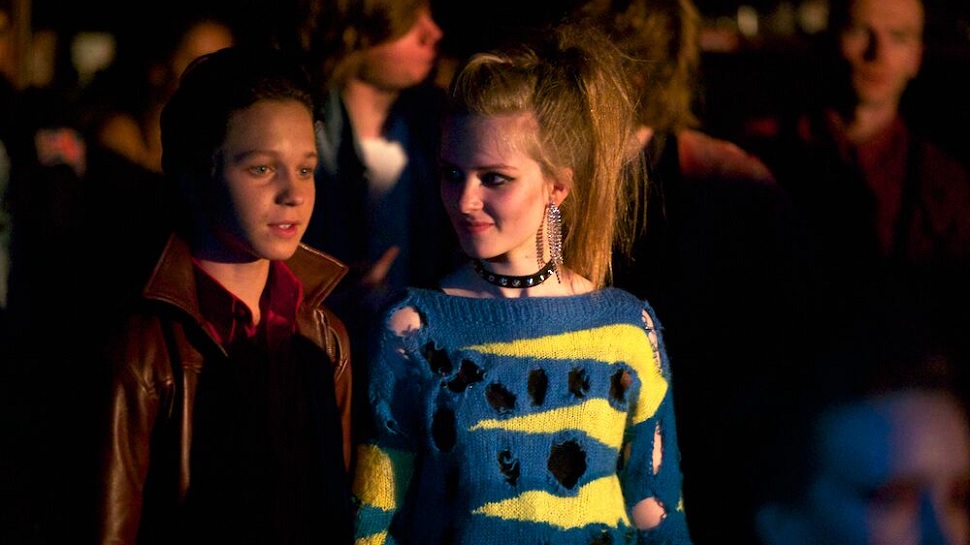


I loved the way the movie portrayed young love in a realistic, unglamorous way. Shay is awkward, gawky and unsure of himself, while Vivian seems  the polar opposite: self-assured, sexy, cocky and cheeky.

In other words, Vivian's kind of the guy in the relationship, and Shay's more like the girl- one assumes a conscious reflection of his other role, as a stand-in for his own mother in his family. Note also how he literally has to dress in drag to pass for older in order to pull of driving a cab as someone who's underage, further demoralizing the poor kid. 


I thought all of this, even if unintentionally so, was a clever way of dealing of the sort of gender issues that we're dealing with now in society, what with all the new terms of classification to that end, and the fact that people are starting to wise up that associating certain things with certain genders is kind of wrong (i.e. boys wear blue, girls wear pink; girls are "supposed to" dress a certain way, while boys are "supposed to" dress another, etc.).

The way the movie reflects our current times doesn't end there, either. For instance, we also see groups of people protesting the influx of immigrants into England and declaring the superiority of whites. Hmm...why does that seem so familiar? 😏 (Interestingly, though, the film was actually initially released in 2016, before the election. The more things change, the more they stay the same, I guess.)


Although, some of the events in the film are a bit dubious- would the cops really arrest a little kid like that, much less beat him down with a nightstick? Maybe back then, who knows. But what is the likelihood that he would be locked up with freaking Joe Strummer? After picking him up not once but twice in his cab? 

That sort of questionable plotting notwithstanding, it's sort of interesting how the film strives for downbeat realism in some aspects- the squalid surroundings Shay lives in, in his small town; not to mention his mother's iffy lodgings in London; the protests and riots; the fact that Shay has to take over for his dad when he's injured, and so on. 


On the other hand, it's sort of a fairy tale in others: Shay meeting Strummer and the two becoming sort of unlikely mates, to the point that Strummer later on cancels a gig (!) to attend the re-opening of Shay's father's music shop after Shay takes it upon himself to sell all the pianos and buy guitars and the like and make it into a "rock shop" instead.

In other words, the film kind of wants to have its cake and eat it too, even to its detriment. I mean, don't get me wrong: I'm glad that the film has its fun moments, otherwise it might have been too dreary and heavy-handed. But it does strain credibility at times, admittedly. 


That said, if you can just not try to read too much into it and ignore some of the chronological issues, it's an entertaining enough movie, anchored by strong performances across the board. Meyers turns in a solid turn as Strummer, doing his own vocals more often than not (fear not, there's enough of the original tunes in there to please purist fans), although the rest of the band gets short shrift by the very nature of the plot.  


The kids are all great, and give very natural, surprisingly nuanced performances, while Scott and McElhone likewise serve as an excellent point-counterpoint of the way opposites can both attract and drive people apart. The film's portrayal of young love is also right on the money, and strikingly realistic, notably in a somewhat cringe-inducing love scene. (The kids are supposed to be 14-15 years-old, after all.)


The director is Derrick Borte, who did the underrated comedy/drama The Joneses, with David Duchovny, Demi Moore and Amber Heard, which is well-worth seeing. I thought this was even better than that film, and I was actually a bit surprised to learn that the director was American, given how realistic the depiction of England was. (Okay, technically, he was born in Germany, but brought to the US before he was even a year old, so... might as well be American, really.)


And, perhaps needless to say, the soundtrack is phenomenal, and not just because of the copious amounts of The Clash featured. There's also The Ramones, The Buzzcocks, Toots & The Maytals and others, so it's not just all-Clash-all-the-time.   

While Clash fans might be disappointed that this is more of a coming-of-age story with the punk rock scene serving as a back-drop and not the focus of the story, it worked for me. 


Besides, if you want more Clash, you can always check out Rude Boy or any of the number of documentaries on the band (The Rise and Fall of The Clash is a good one) and the excellent one on Joe Strummer, The Future is Unwritten.   


Regardless, I quite enjoyed London Town. While I may have been raised in the South- about as far from England as one can get, comparatively- I definitely related to the working-class environment and what it was like to discover punk rock for the first time and fall for an older (if not necessarily wiser) girl. 

And like I said, there are obvious parallels between what was going on then and what is going on now in He-Who-Will-Not-Be-Named's America, so it felt timely, in spite of being set in the late 70's. 


So, if you like punk rock music- and especially The Clash- and you can get past some historical inaccuracies, and if you enjoy a good coming-of-age drama, then you should love this one. It's not perfect, and some of it strains credibility, but that's why they call them movies and not documentaries. 


London Town is readily available on DVD and for rental on Amazon and other streaming services.

Check it out!

Emoji Review: πŸ‘ͺπŸ’₯πŸ‘¦πŸ‘·
πŸŽΆπŸ‘«πŸ’žπŸ”žπŸ’ƒπŸš•πŸŽΈπŸͺ


Friday, June 22, 2018

Flashback Friday: House of Death (aka Death Screams) (1982)

Writer's Note: Normally, I try to get the best quality pictures I can. Every now and then, I might use a more sub-par one because it's the only one available for a certain scene or actor, but on the whole, I'd rather use a decent picture from a film over a crappy one, even if it is more relevant, for obvious reasons.

However, as you might guess, some films are harder to find pictures for than others- the more obscure they are, the more the chances of finding quality pictures becomes harder. This was one of those cases, even more so than usual for a lesser-known flick. My apologies for the unfortunate quality of the majority of photos this time out- I tried my best! 😞


Some of the movies I review here I have a long, illustrious past with that dates back to my childhood. Others I'm seeing for the first time. Then there are the ones that I've only seen a few times, but have a troubled history with, for one reason or another, such as the versions I've seen in the past look like crap (i.e. Humongous, which I finally saw in a far superior quality version a few years back, after having only seen the VHS version as a kid and not being able to tell what the hell was going on, half the time).

House of Death, aka Death Screams, is one of the latter. I first saw it around a decade or so ago, when I chanced upon it searching for obscure slasher movies I hadn't seen on eBay. I bought the DVD, and it turned out to be one of those pseudo-bootleg releases where they pretty clearly dubbed a copy of the film from VHS, which sort of defeats the purpose of a DVD, which are, of course, known for having better picture and sound than the likes of a VHS.


So, right off the bat, the quality factor was disappointing, but then things actually managed to get worse, believe it or not. As those of you who also got a hold of the same version I did (from Vipco, FYI, as pictured) already know, no doubt, adding to the misery was the fact that the film was dubbed out of order!

As such, characters who were shown to be killed would pop back up without explanation, and the plot was even more jumbled than it already was, making for a decidedly frustrating viewing experience. As much as I love David Lynch and his often non-linear approach to film-making narratives, this was ridiculous.

Also, keep in mind, I didn't realize what had happened until later on, when I put two and two together after the fact. In addition, I did a little on-line research and confirmed that others had the same experience, so I knew I wasn't just crazy. Or, not crazy in terms of this particular thing, lol. 😡


To make matters worse and add insult to injury, it turns out that it was a heavily-edited version of the film which ran around an hour-and-twenty-five minutes. I did eventually find a version of the film online, which was in the correct order, but still the edited version, so my second viewing experience wasn't much better than the first, albeit at least a bit more coherent this time around.

All of which is to say, I don't have a history with the film, nor were my first viewing experiences positive ones. As such, I'm not exactly sure what compelled me to put myself through the wringer yet again, but I'm happy to say that the third time was indeed the charm. Go figure. 


For, you see, the stars were aligned this time around. While the quality of the film was still a bit on the shoddy side, visually, the sound was fine, the film was uncut and in order, and I was just plain in the right frame of mind to watch the film again, with just enough time having elapsed for absence to make the heart grow fonder, as it were.

And you know what? I really enjoyed it this time, which is rare for me. Typically, if I don't like a film the first time around, that's it for me. It takes a lot for me to watch such a film a second time, but every now and then, I will, particularly if the critical mass has shifted, making me wonder if I was wrong.

After all, a lot of the time, critics have to make snap judgments, so it's not unheard of them to reverse their stance after giving a film a second chance, once they've had a little time to sit with things, and get a sense of what others think, and wonder if they missed something the first time around. 


Not that, mind you, House of Death is some lost, hidden gem that deserves to get the full-on Blu-Ray bells and whistles edition, per se, but I would certainly re-buy it if they did do such a thing, if only for the improved picture quality. As it stands, the so-so DVD copy will have to do for now- just make sure you get the proper, uncut sequential version, by all means! (You can watch one here, on YouTube, as of this writing, but as a rule, on DVD, look for the version that runs just over an hour-and-a-half, as opposed to 1:25.)

The plot is pretty simple, standard slasher movie fare. Around the time of a small Southern town's local carnival, young people start getting bumped off one by one by an unseen maniac, typically armed with a machete, but also the occasional bow & arrow, garrote, or plastic bag, a la the killer in Black Christmas. 


Eventually, the killer goes on a full-on murder spree, after he follows a group of "kids" (and I use that term loosely, given the age of the actors playing them) from a riverside bonfire to an old graveyard (cue the spooky ghost stories), and finally, to an old, abandoned house nearby, which they seek shelter in after a rainstorm breaks out- presumably the House of Death of the title, which is a bit of a misnomer, given that only about ten minutes or so of the film is actually set there. 


In the film's uncut form, it's pretty damn gory- at least when you can see what's going on- with several decapitations, one girl cut in half (shades of last week's Flashback Friday, Stage Fright: Aquarius, which features a very similar scene) and a brief-but-highly-amusing head explosion, which somewhat comes out of nowhere and is hilariously edited for maximum silliness. 

The person in question has their throat slashed, falls from a window, impales themselves, and is basically already dead, when someone else fires a gun at them, blowing up their head somehow, Scanners-style, only not as good, effects-wise. That someone is then shown to continue to fire their gun, even long after said head explodes! It's pretty great, and nearly worth the price of admission, I must say. 


While the film is admittedly leisurely-paced, I actually really enjoyed it a lot this time around. For one thing, I have a soft spot for films that revolve around carnivals, state fairs, and amusement parks, i.e. The Funhouse, Something Wicked This Way Comes, Rollercoaster, etc.

For another, I was born and raised in the South, so I appreciate it when a film has a distinctly Southern flair that is authentic and not put on. The older actors in particular feel real and I liked the way the film forms its own sort of self-contained world with as much unspoken as it is directly addressed. 


For instance, the scene where the Coach meets a girl at the carnival who offers him some baked goods and flirts heavily with him, then gets all ticked off when she spots him making eyes at another girl later on and passive-aggressively takes it out first on another customer, then the Coach's car with a can of whipped cream.

You get a lot of information there, and much of it is unspoken, but all too familiar, especially to us Southerners, who know a thing or two about such women- there's a reason the whole "Southern Belle" thing has become such a stereotype, believe you me. Half the time we men don't have a clue what we did wrong, but you better believe we find out the hard way when we do, lol. 


Alas, this particular Belle also finds out the hard way what happens to those who act out of spite- especially towards someone who already is a few nuts short of a pecan pie. (Spoiler alert, I guess, not that it matters much in this case, as there's absolutely NO indication of who the killer is until it's revealed, and their back-story/motivation is muddled at best -not to mention, you can barely tell who it is in the first place.)


We also get some nuggets of info about the various denizens of the town through dialogue, and though much of it is admittedly irrelevant, it does help with the movie's interior world-building, and I highly appreciated it for that very reason. 

For instance, we learn that Lily's grandmother, who is sort of the town gossip, has been lying to her daughter about who her father really is since she was a child- and that Lily has known it for years, thanks to seeing the same photograph that grandma has been passing off as her dad in a random picture frame she saw in a store! 


In another scene, it's implied that a guy we heretofore assumed was mentally challenged may have actually done it to himself, when he and a former girlfriend were out drinking and driving and he wrecked the car. She emerged relatively unscathed (physically, anyway- but mentally, not so much), but the guy in question is seriously messed up, peeping at girls and skulking around town spying on people.  

Ever since that accident happened, the boy's father, the town Sheriff, has blamed the girl, Ramona, calling her out as a "whore" or the like every chance he gets, something she obviously resents, given that it wasn't her fault it happened in the first place. Note also that Grandma also has a few choice words for Ramona as well, implying that it is a sentiment held by most of the town, which is probably why Ramona is so messed up. 


The film's writer didn't have to include these sort of details, but he did, making this a cut above some of the more cookie-cutter slashers of the era, even if it seems like more of the same on the surface of things. I mean, don't me wrong- it ain't exactly Shakespeare, but if you've seen as many of these sorts of films as I have, you learn to appreciate the little things. 

I guess my main complaint, beyond the obvious poor picture quality/possibly shoddy cinematography (by the same guy who shot the slasher Final Exam), is that the killer's motivations are so muddled. We get a quick flashback, showing that his mother was a stripper, and likely a prostitute on the side, and that's about it. 


Maybe it would make more sense if he were only killing women, but he's basically just killing people at random that he comes across, albeit often when they're making out, skinny-dipping, etc. And yet, he doesn't kill the "bad" girl when she comes on to him, sneaking into his house and into his shower! (Nice role reversal on that shower scene, incidentally, given that it's usually women stalked in the shower in these movies.)

What's more- and this is such a Southern thing, too, I might add- the film also goes out of its way to have the couples that are having sex declare their love for one another at some point before they do the deed. For instance, in the opening scene, the girl won't go all the way until the guy says it- fat lot of good it does either of them, as they are killed shortly thereafter. Who does it on top of a motorcycle, anyway? Serves him right, getting it caught in his zipper, lol. 


So, yeah, House of Death isn't the best slasher you will see, but it is better than average, thanks to details like that, and a really likable cast of characters that you really feel like you know by the end of the film. I could have dealt with a little more motivation-wise from the killer, but overall, it's a small quibble.

As with a lot of obscure horror films, there isn't much in the way of star quality here. As tends to be the case, many of the cast only have this film or a small handful of credits to their name, making a more thorough take on the cast and crew an uphill battle. But I'll do what I can. 


Oddly enough, the most famous person involved is the director, former actor David Nelson. If you're one of my older readers, then you know that name as one of the children of none other than Ozzie and Harriet Nelson, as in "The Adventures of..." and brother to teen heartthrob Ricky.

If you're closer to my age, aka a child of the 80's, then you probably know him better as the father of Matthew and Gunnar, those long, flaxen-haired pseudo-metal rockers of the early MTV era. (Here's their big hit, for those who dare to click.) 


David's also the uncle of Tracy, known for her turn in 80's TV shows like the much-beloved Square Pegs and Father Dowling Mysteries, as well as genre stuff like The Night Caller, The Perfect Nanny, Home the Horror Story (with Twin Peaks vets Richard Beymer and Grace Zabriskie), Fangs, Killer Bees and My Stepbrother is a Vampire!?! (their punctuation, not mine), plus lots of Lifetime/TV thriller movies and the episode of Seinfeld where he dates a girl that looks a bit like him, "The Cartoon." (She would be that girl.)


David eventually drifted out of acting in the early 80's, formed his own commercial production company, and turned to directing full-time, after getting his start directing his parents' show. He made his motion picture directorial debut with Childish Things (alongside John Evans and his then-wife, Linda, pre-Dynasty), following that up with a documentary about his brother Ricky's tour, Easy to Be Free. 

After House of Death, he made Last Plane Out and Rare Breed, both of which he also produced, but largely dropped out of the business thereafter, save a small role in John Waters' classic Cry-Baby, as Wanda's father. Sadly, House of Death was his only foray into horror.


The film's lone "big name" was Susan Kiger, who has the dubious distinction of being one of the rare Playboy Playmates to have done porn before her stint in the magazine. However, if you grew up with pay-cable movie channels like I did, you probably know her better for her string of B-movies.

They include Angels' Brigade, a sort-of Charlie's Angels knock-off; the action/thriller Seven (alongside some of her fellow Playmates); the self-explanatory The Happy Hooker Goes Hollywood, and the sci-fi B-movies The Return (with Cybil Shepard, Martin Landau and Raymond Burr) and Galaxina (starring the ill-fated Playmate Dorothy Stratten). 


However, Galaxina notwithstanding, which Kiger only had a small role in (she was the blue alien hottie), the film I most associate with her is undeniably H.O.T.S., which, if you saw at a certain age, you're not likely to have forgotten. It was best-known for a nude football-playing scene. Talk about shirts and skins, lol. 😻


Oddly cast against type in HOD as a goody-two-shoes virginal type- she doesn't even do nudity in the film- Kiger is actually pretty good, and even convincing, especially if you don't know her background, which I wasn't as aware of when I first saw this film. The minute I saw H.O.T.S. on her resume, though, I knew exactly who she was. Sadly, this proved to be her final film before she retired from the business to become a hair dresser. 


From here on out, things get pretty spotty. Interestingly, as with last week's selection, there's another movie out there, which serves as a bit of a class reunion of sorts for fans, Dogs of Hell, aka Rottweiler, features this film's stars, Helene Tryon (aka Edna, Lily's grandmother), Larry Sprinkle (who plays Ted), John Kohler (who played Diddle) and Curt Rector (aka Kurt Rector, who plays Bob), so be sure and check that one out if you're a fan of any of those actors or if you just want a fun dogs-gone-amok flick.


In addition, William T. Hicks, who played Sheriff Avery, and Hanns Manship (aka Bud French), who played Casey, were both in the 1981 slasher A Day of Judgment, alongside Helene Tryon and Larry Sprinkle, making it yet another family reunion of sorts. That film, which I hope to get around to reviewing here someday, is also worth seeing. Larry Sprinkle was also in Another Son of Sam, Firestarter, Trick or Treat (a personal fave of mine) and King Kong Lives. 

Hicks and Martin Tucker, who played the Coach, were also in the movie New Girl together, with the latter once again playing a Coach character. Manship had small roles in the cult favorites Audrey Rose, The Fury and Eating Raoul and Tucker cropped up in Maximum Overdrive. 


David Lenthall, who played Jackson, has the lengthiest resume of them all, having appeared in some 36 projects. Some of them include: Her Deadly Rival, Empire Records, The Stepford Husbands, The Lottery, The Rage: Carrie 2, Cherry Falls and Vampires Anonymous. He's also done lots of TV, including The Young Indiana Jones Chronicles, American Gothic, Dawson's Creek and several episodes in the Law & Order franchises. 


After that, it's slim pickings. Andrea Savio, who played Kathy, was once married to Tony Curtis (thus making her Scream Queen Jamie Lee Curtis' stepmother for a while) and was in the fun post-apocalyptic sci-fi action flick Stryker. 


Jennifer Chase, who memorably played Ramona, the "bad girl," also has a Tony Curtis connection, having co-starred with him in the film Balboa, which also features cult faves Martine Beswick (Dr. Jekyll Sister Hyde), Carol Lynley (The Cat & The Canary), Chuck Connors (Tourist Trap) and none other than Cassandra Peterson, aka Elvira, Mistress of the Dark.  

Jody Kay, who played Ann, was in the action flick The One-Armed Executioner. Mary Fran Lyman, who played Agnes, was in Brainstorm. Penny Miller, who played Angie, was also in The Hollywood Knights, another old-school fave of mine, which is like a B-movie version of American Graffiti and stars a young Michelle Pfeiffer and Tony Danza. 


Finally, there's the amusingly-named Gene Pool, who played the gruff type that kept getting turned down at the kissing booth. He also has a bit part in the slasher Final Exam, and was a frequent camera and electrical department worker on such films as Shag, Little Monsters, Prancer and The Exorcist III.  


Paul C. Elliott, who wrote the script, was the head writer on the TV variety show Dolly, starring country legend Dolly Parton, which makes an odd kind of sense, given the realism of the Southern characters. 


One of the more unintentionally hilarious elements of the film is the score, which ranges from sounding like the house band at an early 70's Oscar ceremony (the title theme) to a Jamaican steel drum ensemble (the chase scene in the graveyard)- in other words, oft-completely-inappropriate.
In spite of this, the music is from the renowned Dee Barton, who actually started out solid as a film composer, providing the music for a string of Clint Eastwood classics, including Play Misty for Me, High Plains Drifter and Thunderbolt and Lightfoot. Maybe his bombastic stuff was better-suited to those films, but it sticks out like a sore thumb here.

He continued to score more B-Movies for producer Earl Owensby (Tales of the Third Dimension, Unmasking the Idol, etc.), but his film composing career cratered in the late 80's and he went back to playing and arranging music professionally with a Big Band vibe afterwards, which was probably for the best. 


House of Death may not win any points for originality, but I dig the carnival setting, the authentic Southern atmosphere (the film was shot on location in North Carolina), and the wacky gore. The writing is slightly better than it has to be, and the acting is pretty decent for a film of this type, which has to count for something.


Granted, the titular house barely makes an appearance, and the lighting is atrocious, and I had to watch the film three times before I got a decent copy, but just make sure you get the right one from the start and you should be fine. And, perhaps needless to say, if you're not a slasher movie fan, this probably won't change your mind. 


But I suppose it says something that I was willing to watch this three times to "get it right" and I don't regret it, so there's that. Just temper your expectations and prepare to be pleasantly surprised, if you like this sort of thing.

I know I do- I could watch a hundred slasher movies and still enjoy it, in spite of the predictable formula- and I probably have, at this point. Long live the slasher movie!  


By all means, check it out!

Emoji review: πŸ˜ŽπŸ’¦πŸ’πŸ˜±
πŸ’€