Writer's Note: Sorry for the low profile over the last few days, but I had some personal things to deal with. Furthermore, it kept me from watching much in the way of movies, either- in fact, this movie I'm reviewing today is the only one I've seen in some time, and it was a bit of a fluke.
In addition, there weren't a lot of potential birthdays to tie into past articles, so I couldn't even find something to just post on the fly in the meantime.
However, that may change soon, as I found a new website that not only features birthdays, but also days celebrities passed away and a "this day in film history" feature, which should offer up more opportunities to tie into old articles as well.
Thanks for your patience in this matter. Also, know that it hasn't gone unnoticed that my horror and cult-themed articles tend to do the best, in terms of overall views. Expect to see more of those moving forward, for sure!
Now, without further ado...

Originally released in the summer of 1984- the same year Prince's feature film debut Purple Rain ruled the box office- Streets of Fire was somewhat unfairly maligned by critics, and tanked big-time at the box office, despite the high level of talent involved.
At the time, writer-director Walter Hill was riding high on the massive success of the Eddie Murphy/Nick Nolte vehicle, 48 Hours, one of the top-10-grossing films of 1982. Critically adored and a commercial success, it gave Hill and producers Joel Silver and Lawrence Gordon carte blanche to do whatever they wanted, and what they chose to do was Streets of Fire, a so-called "rock 'n' roll fable."
The idea was to capitalize on both teen films, then-hot because of the likes of John Hughes (Sixteen Candles, The Breakfast Club); and musicals, also-hot, in light of the enormous success of Flashdance the previous year. The bulk of the cast was under 30, including star Diane Lane, who was merely 18 at the time.
Hill originally envisioned someone older in Lane's role, but her level of commitment was such that he gave her the role anyway and simply aged her up on screen by dressing her in a more mature way to make it more believable that she would be around the same age as leading man Michael Paré, who was seven years older.
Of course, if you know your cult films, then you already know that Lane was no stranger to playing a rock star on the big screen, having done so in the criminally underrated Ladies and Gentlemen, The Fabulous Stains, which I hope to review here before too long.
However, Lane's voice wasn't strong enough as a singer, necessitating several "ringers" to be brought in to substitute, which she later lip-synched to on set. Co-star Paré was no stranger to this, either, it's worth mentioning, having also done so in the cult hit Eddie & The Cruisers the previous year- though he didn't have to "sing" for this film.
Lane's character's vocals were done by Holly Sherwood and Laurie Sargent, who go by "Fire, Incorporated" on the film's soundtrack. Oddly, though, despite the excellent work by these singers, they themselves were likewise partially replaced on the soundtrack on the tracks "Sorcerer" and "Never Be You" by, respectively, Marilyn Martin (who hit it big with a #1 duet with Phil Collins the following year: "Separate Lives" from the movie White Nights) and Maria McKee (of the indie band Lone Justice- she also crops up on the Pulp Fiction soundtrack).
If a lot of the music has a familiar ring to it, there's a reason for that. A good portion of it was produced by none other than Jimmy Iovine, who recruited some of his own talented roster of artists to contribute.
None other than Stevie Nicks wrote "Sorcerer," in fact, a song which dates back to her pre-Fleetwood Mac, Buckingham-Nicks days. She would later re-record the song herself for official release with Sheryl Crow on the album Trouble in Shangri-La.
Meanwhile, "Never Be You" was written by Tom Petty and Benmont Tench, of his backing band, The Heartbreakers. Finally, "Nowhere Fast" and "Tonight Is What It Means To Be Young"- both credited to Fire, Inc.- were written by Meat Loaf and Bonnie Tyler mastermind Jim Steinman.

Despite all this talent involved, interestingly, the film's biggest hit was by a relative unknown (to modern audiences, at least), Dan Hartman, entitled "I Can Dream About You." Hartman at that point was best-known for writing "Free Ride" by the Edgar Winter Group, before going disco with the smash hits "Instant Replay" and "Relight My Fire."
He would later find even bigger success writing and producing songs for the likes of James Brown (the even-bigger hit, "Living in America" from Rocky IV), Tina Turner, Steve Winwood, Joe Cocker and Paul Young.
Oddly, once again, the film chose to replace Hartman's vocals with singer Winston Ford's- though his vocals were then lip-synched on-screen by actor Stoney Jackson! (The 80's were a confusing time.) Fortunately for Hartman, the soundtrack version was his own, and became a Top 10 hit that summer- a bigger hit than the movie, in fact.

Rounding out the soundtrack are two songs by the retro-rock act The Blasters, who initially turned down an appearance in Hill's 48 Hours, but reconsidered after that film's success and landed a bit in this film, performing their original "Blue Shadows" and a cover of Leiber-Stoller's "One Bad Stud."
Originally, the titular song, "Streets of Fire," by Bruce Springsteen, for which it was named, was intended to close out the film, but reportedly Springsteen balked when he heard the filmmakers intended to- you guessed it- have someone else cover the song, which seems sort of silly. Why not just go with the original?

Instead, an original song by, of all bands, The Fixx, "Deeper and Deeper" was used. Initially a B-side to their single, "Are We Ourselves?", the song proved a sleeper hit for the band, outperforming the A-side in terms of radio airplay. An extended version of the song can be found on the CD release of the band's album Reach the Beach, as well as on many of their various greatest hits collections.
It's a great song, but it doesn't exactly fit the vibe of the movie, and as a direct result, feels like the last-minute tack-on that it is, unfortunately. Pity, as the rest of the soundtrack is pretty great, and establishes its own distinct vibe. Indeed, for many, it's the soundtrack that's the most memorable thing about the film.

I should also note the excellent score by Hill's then-go-to composer Ry Cooder, which, sadly, has never been released in any format, save his lone contribution to the soundtrack, "Hold That Snake."
It's too bad, as Cooder's work here is just great, holding its own with his other scores of the time, which notably include the Mick Jagger vehicle Performance; Wim Wenders' Paris, Texas (which musician Dave Grohl has cited as one of his all-time favorite albums) and Crossroads (the 1986 version, not to be confused with the movie with Britney Spears).
Getting back to the cast, in addition to Lane (then coming off the star-making, back-to-back S.E. Hinton-based young adult novel adaptations of The Outsiders and Rumble Fish, both directed by Francis Ford Coppola) and Paré (who got the role after Tom Cruise had to opt out over a prior commitment, winning it over the likes of Patrick Swayze and Eric Roberts), the film is filled with other soon-to-be big named up-and-coming stars.

As Lane's character Ellen Aim's manager/boyfriend, there's Rick Moranis, then best-known for the variety show, SCTV (sort of Canada's answer to SNL). Later that same year, he would fare decidedly better with the massively successful Ghostbusters and its sequel.
He would then go on to appear in the hits Little Shop of Horrors (another musical), Mel Brooks' sci-fi spoof Spaceballs, and the sci-fi family film Honey, I Shrunk the Kids and various sequels to that film. Reportedly, his on-screen persona wasn't far from his real-life one, as he and Paré didn't get along at all.

As the leader of the motorcycle gang that kidnaps Ellen- onstage during a performance, no less! (someone needs better security, to be sure)- there's a young Willem Dafoe, in his second major role following bit parts in the major bomb Heaven's Gate and the excellent vampire flick The Hunger (featuring rocker David Bowie).
Interestingly, his first big role was also as a rebel biker type in The Loveless, a film co-written and co-directed by Kathryn Bigelow (who would go on to make film history as the first female director to win the Oscar with The Hurt Locker).
Dafoe would, of course, go on to much success, particularly in villainous roles in movies like David Lynch's excellent Wild at Heart, Shadow of the Vampire, To Live and Die in L.A., Spider-Man and Once Upon a Time in Mexico. More recently, he received an Oscar nomination for an atypical turn in the indie flick The Florida Project.

Arguably the best role in the film was originally written with a man in mind- that of McCoy, a fellow former soldier pal of Paré's character, Tom Cody. But when actress Amy Madigan, who was there to read for the role of Cody's sister, suggested that it be a woman instead, Hill took her up on it and cast Madigan in the part with only minimal changes.
Somewhat ironically, this has led many to speculate that the character was intended to be a lesbian, even though she mentions an ex-flame that was a male in the film. Still, many thought that this was merely a "cover story" to hide her "real" identity. Intentional or not, I like the theory, and either way, it's a great character.
Madigan went on to huge success in many Oscar-nominated films like Places of the Heart, Twice in a Lifetime, Field of Dreams, Pollock (with husband Ed Harris, who also produced and directed) and Gone Baby Gone, as well as crowd-pleasers like Uncle Buck.
Even the supporting roles in this one are filled with some familiar faces. For instance, as members of the Sorels, the doo-wop group featured in the film, there's Mykelti Williamson, who would go on to appear as "Bubba" in Forest Gump and in lots of TV, including Hill Street Blues, Boomtown, CSI: NY and Justified; as well as then-future producer/director Robert Townsend, of Hollywood Shuffle, Eddie Murphy's Raw and the classic The Five Heartbeats, which also revolves around an African-American doo-wop group.
Cropping up as a bartender is Bill Paxton, who, after a bit part in James Cameron's classic The Terminator, would go on to hit it big the following year with supporting roles in Cameron's Aliens and John Hughes' Weird Science. Paxton later became of of Hollywood's most respected character actors, both in movies and TV, notably in Tombstone, Apollo 13, Twister, Titanic and HBO's Big Love.
Look quick for Ed Begley, Jr. (Arrested Development, Better Call Saul) as a street informant, and comedian Kathy Griffin as a concertgoer. Plus, if Dafoe's character Raven's right-hand man looks familiar, you must be a punk rock fan- that's none other than Fear lead singer, Lee Ving. He also cropped up in Flashdance, Fame and Clue, among other films.
Worth a mention are Richard Lawson, as the police chief, who was in the classic Poltergeist (as one of the parapsychologists), as well as genre faves like Scream Blacula Scream, Sugar Hill, Audrey Rose and TV's V miniseries; and Rick Rossovich, as his right-hand officer, also from The Terminator, plus Top Gun, Roxanne, Navy Seals and TV's ER.
Then there's the adorable Elizabeth Daily (aka E.G. Daily), of Valley Girl, Pee-Wee's Big Adventure, Loverboy and Dutch, plus countless voice-over work, notably as Tommy Pickles on Rugrats and Bubbles on The Powerpuff Girls, as well as the voice of Babe, the pig, in several movies.
TBH, the first time I saw this, I wasn't a huge fan, partially because I've never been crazy about musicals, but as I've gotten older, I've gotten a little more tolerant of them, especially those from the 80's, the era in which I was a kid.
Mainly I just don't like the ones in which people just burst into song out of nowhere, but here, it happens organically, as in they're performing on-stage or in music videos or the like, so it's much more tolerable. Also, the music just so happens to be pretty good, which doesn't hurt.
While the acting can be a bit over-baked at times- a matter not helped by the would-be Noir-speak of the script, to be sure- it's undeniably fun to see a bunch of soon-to-be stars in their early years, and Lane looks amazing, making you wish she'd done more glamorous roles like this one.
You might also want to check out Francis Ford Coppola's underrated The Cotton Club, from the same year. While it revolves around the jazz era, Lane is suitably glam in that one as well. It was recently re-released in an extended cut (aka The Cotton Club Encore) that is well-worth seeing, even if you've already seen the film before.

Also worth a mention is the look of Streets of Fire, which, in spite of its seeming to be set in the past (apparently Chicago in the 50's, though the film itself refers to it only as "another time, another place"), practically screams the 80's at times. Initially shot in Chicago itself, the production was moved to L.A. because of inclement weather causing it to get behind schedule.
Once in L.A., the production designers set about recreating Chicago on the Universal Studios back-lot at great expense, ballooning the cost of the film. Not helping was the fact that the film was mostly set at night, which required a massive tarp to be made to cover the entirety of the set in order to shoot day-for-night, which cost some $1.2 million!

Cinematographer Andrew Laszlo also did the honors for Hill's cult classic The Warriors, which shares some similarities with this film- both revolve around street gangs, and feature actress Deborah Van Valkenburgh (also of the TV sitcom "Too Close for Comfort," with Ted "Caddyshack" Knight).
Other films of note he shot are the underrated horror flick The Funhouse (from Texas Chainsaw Massacre director Tobe Hooper), First Blood (aka the first "Rambo" film), Poltergeist II and Star Trek V and TV's Shogun miniseries. Streets of Fire has a very distinct Blade Runner vibe, which probably wasn't by accident, though the subject matter is obviously worlds away.

I also love the final showdown between Tom Cody and Raven, in which they go at each other with sledgehammers. Reportedly, it took nearly four weeks to shoot!
Originally, Cody was meant to kill Raven with a knife, but wanting to earn a PG rating so that teens could see the film, Hill changed his mind and toned things down, letting Raven emerge alive at the end of the fight. Also, the movie was intended to be the first in a trilogy of films, so Hill wanted his villain to live to fight another day in the sequels.

Interestingly, in my research, I discovered that one of those films was indeed eventually made, albeit not by Hill. 2008's Road to Hell, directed by Albert Pyun (of The Sword and the Sorcerer and Cyborg fame) also features Paré as Cody, as well as Valkenburgh as his sister, with songs by a returning Jim Steinman and The Roxy Gunn Project.
Singer Gunn also takes over Lane's role as Ellen Aim, this time doing her own singing. I haven't seen it yet, but I will try and seek it out and review here ASAP, assuming I can find it, as I'm genuinely curious about it.

While it might be a bit of a stretch to call Streets of Fire a "classic," per se, it certainly fits the bill as a cult classic, at the very least, and if you're a fan of any of the aforementioned actors or musicians, you'll definitely want to see it. Likewise, if you dug The Warriors and can deal with some light singing, you should like this as well.
At just over an hour and a half, it zips by, never really stopping to catch its breath, which I really liked. Too many movies these days are overlong, so it was refreshing to see one that knew exactly when to say when and not overstay its welcome.
It's also worth mentioning that, while the film was roundly panned in its day, it has been reassessed since, and you'll find mostly glowing reviews, especially on IMDB, though it fares only so-so on Rotten Tomatoes. But trust me, the people who love this movie, REALLY love it. Maybe you will too. (The film is readily available on DVD and Blu-Ray.)
Check it out! 👍😍
After last week's Flashback Friday review for A Night to Dismember, I received a comment on social media about how someone loved the film for precisely the reasons I dismissed it- they even offered to buy the DVD from me! (I probably would have sold it, too, if I hadn't watched it online, lol.)
That got me to thinking- was I even able to enjoy bad movies the way I used to, back before I knew any better? Put another way, before I really had a sense of how films "work," before I went to film school, before I started reviewing movies & TV and so forth for money?

After all, a lot of the bad movies I love were sort of grandfathered in from when I was a kid/teen. Sure, I've enjoyed some of the more modern stuff that's been released since, such as The Room, Birdemic and what I've seen of the Sharknado series, but the last ones in particular seem to be purposely "bad," and clearly in on the joke.
Ditto the more recent Piranha flicks, although being knowingly camp can just as often backfire, i.e. Cabin Fever 2, which you'd never guess was directed by the otherwise talented Ti West, of House of the Devil and The Innkeepers fame. Maybe it's a creature feature thing, as I tend to give those Syfy-Saturday-night-type movies a longer leash on being silly, as they ALL tend to be that way.

The point being, it's actually harder to find a "so-bad-it's-good" kind of film these days, so, as a direct result, I've seen less of them that fit the bill. (Not everything can be lightning-in-a-bottle like The Room!) That was part of the reason I decided to dip back into the past for some of those types of films, noting that they were more readily accessible in the internet/DVD/Blu-Ray age.
Unfortunately, if you look back at some of my choices as of late, in terms of the movies I haven't ever seen before, it's been more miss than hit. Had I lost that childhood sense of wonder that made such films so enjoyable once upon a time?

Well, I'm happy to say that, with today's choice, Night of the Demon, I finally hit pay-dirt. The gratifying thing is, I wasn't even really trying to do so, it just happened randomly. In fact, TBH, I think the film I really meant to watch was Demonwarp, which has a similar set-up, but I got the titles mixed up- understandable, given their similarity.
The interesting thing is, a lot of NOTD's failings are pretty damn similar to A Night to Dismember. On the plus side, it isn't all narration like that film, which my loyal readers know, is a pet peeve of mine- I consider it to be a crutch for most films, with certain rare exceptions, i.e. A Clockwork Orange.
But most everything else I actively disliked about Dismember is present and accounted for here: bad acting (though, to be fair, it was hard to tell with Dismember, as what little "acting" we saw was dubbed), iffy editing choices, inappropriate
music, et. al. And yet, here it worked for me. But why?
As with last week's selection, I watched the film alone, as it was a Thursday night, and it's hard to get friends over to watch something on a weekday once you hit a certain age. Hell, you're doing good to get some of them even on a weekend, really, especially if kids are involved.
I was also stone-cold sober, so that wasn't a factor, either. But then, a lot of those movies I saw as a kid I saw alone for the first time, and (obviously) sober as well, so I'm not sure that's as much a factor as some think, though I suppose a case could be made that being around friends partying a bit helps one to get more into that childhood mind-set than one might watching such things alone.

In this case, it may have, in part, been the general set-up, which hews pretty close to the slasher movie formula, which is a sub-genre I have a soft spot for- it having been the main reason I fell in love with horror movies in the first place, and the sort of gateway to cult movies in general for me.
Of course, Dismember was essentially a slasher movie, too, but it had a distinctly 70's vibe to it, whereas I'm a child of the 80's, so I lean more towards that era, at least when it comes to slashers.
I do love 70's horror, but what could be called the "proto-slashers" of the era often don't do it for me as much as those of the 80's heyday- something about the general vibe, which tends to be pretty humorless and grim: see my review of The Centerfold Girls for an example. Though not always (i.e. the original Black Christmas and Halloween, which are both a lot of fun), to be fair.

NOTD is actually sort of a combination Creature Feature/slasher movie, which might have something to do with it as well, as I love the former, too. Oddly, it's kind of like a proto-Blair Witch Project-type film, believe it or not. Check out this synopsis:
A group of college students and their professor, who arranges the trip, go to a nearby forest in search of a Bigfoot-type creature that has been rumored to be responsible for a series of disappearances and mysterious deaths, some of which we see in flashbacks. Among them is a fisherman, whose daughter also accompanies the group, in hopes of finding out what happened to her father.
Once they arrive, they question the locals, who tell various tales of the creature, as well as an alleged group of satanic worshipers that lurk in the woods, who might be the real reason for all the mysterious goings-on. There's also a mute woman that lives somewhere deep in the woods, driven insane by reportedly having given birth to a deformed baby that died, along with her minister father, under equally mysterious circumstances.

These interviews are quite similar to the ones conducted by the student filmmakers in Blair Witch, and the whole subplot of someone looking for a missing family member was also present in the first sequel to that film. I would be willing to chalk it up to coincidence, if, in fact, one of the BWP directors hadn't gone on to ALSO do a Bigfoot-gone-amok film himself, the enjoyable Exists. So, yeah, they likely saw this one.
Another thing to keep in mind is that this film coincided with the so-called "satanic panic" of the 80's and early 90's, which, if you grew up around then, you undoubtedly probably remember. I certainly do, particularly in respect to music, with heavy metal in particular singled out as a big offender of "promoting" Satanism and Devil worship and the like.

Combining a creature feature with a Satanic subplot is a novel idea, and it really works to make this film stand out from the pack of other similarly-themed films, like Bigfoot (1970 and 1987), The Legend of Boggy Creek films and Sasquatch (1977), among many others. Factor in the slasher movie-esque trappings and you have a pretty fun ride.
The film is also surprisingly gory in places, and even features some equal-opportunity nudity, a holdover from the 70's that later faded out in popularity as movies eventually got more puritanical in the mid-80's, or at the very least, the MPAA did. You will not see the male frontal nudity here coming- much less what happens after!

Needless to say, Bigfoot- or whatever the creature is- goes on quite the rampage, killing most everyone that gets in his way, often in pretty spectacularly violent ways, culminating in a go-for-broke finale in which a whole host of people are killed in a free-for-all massacre that leaves only one person standing. (Not a spoiler- he's the one narrating the story from the beginning from the hospital.)
Factor in the nutty, left-of-center Satanic worship angle, which the film admittedly could have done more with (it's implied that the creature is actually Moloch at one point, which was cool and unexpected), and you have a fun time at the movies, at least as far as I was concerned.

As with Dismember, the cast is relatively star-free, save a few minor actors, such as Michael Cutt, making his debut here as the professor who lives to tell the tale. Cutt also crops up in the slasher Sweet 16 and the home invasion thriller Hider in the House, before becoming a regular face on 80's TV, notably in the sci-fi/horror miniseries Something is Out There.
Cutt continued to work steadily throughout the 90's (he had a recurring role as a cop on 7th Heaven, and was in Kiss the Girls and Kill Your Darlings) and into the 2000's before his career cooled a bit around the middle of that decade. He has several planned features in his future, though, including a horror flick called The Patriarch, so he's got that going for him.

Actress Lynn-Eastman Rossi, who played Susan, had a bit part in the classic Phantasm, though most of her stuff was cut out (you can see more in the deleted scenes on the DVD/Blu-Ray), and also cropped up in Project X (with Matthew Broderick and a monkey), Unlawful Entry and the fun B-Movie throwback Showtime flick Reform School Girl.
Paul Kelleher, who played the Sheriff- and originally had a bigger role to play in the film, as the one who rescues some of the group at the end (the producers decided to kill almost everyone instead- good choice, IMHO)- was in 1977's Meatcleaver Massacre, which sounds fun, and, after taking a break from working after this film, worked steadily throughout the 2000's, notably in Spirits of the Fall, The Demon Within, The Devil Made Me Do It and The Amityville Asylum. Like Cutt, he continues to work to this day, with several new films planned in upcoming years.
Actor Bob Collins had bit roles in the likes of Police Academy and Se7en, and co-star Joy Allen also worked fairly steadily, particularly in British TV.
Jennifer West, who plays the girl who gets it in the van after having sex, was a softcore and X-rated movie regular throughout the 70's and 80's. Her oddly orgasmic attack here is a highlight, bringing to mind the wacked-out dream sequence in Dismembered, as she moans and groans inappropriately as her boyfriend is slaughtered. Hey, you can take the girl out of porn, but you can't take porn out of the girl, I guess, lol.

Finally, there's Shane Dixon, who played the creature. As was typically the case with such roles, it was played by a stuntman. Dixon also did stunts in all sorts of 80's and 90's classics, like Real Genius, Raising Arizona, the Lethal Weapon series, They Live, The Hunt for the Red October, Ghost, Point Break, The Mighty Ducks, Outbreak, Copycat, Breakdown and plenty more where that came from.
It's pretty slim pickings after that, with many of the actors listing this as their sole credit, and others only having a couple of other credits to their names. Likewise, this is the only credit listed for director James C. Wasson, as well as the screenwriter, although it's not THAT bad.

In fact, NOTD is a lot of fun, with a nutty plot and lots of freaky, violent, unexpected moments- such as a Girl Scout attack, a pre-Friday the 13th, Part VII-style sleeping bag kill, a Satanic ritual in the woods- complete with an attempt to impregnate a girl with a "demon seed"- an insane flashback involving the mute woman, her father (who's like the male equivalent of Piper Laurie/Julianne Moore's mother character in Carrie) and the creature; "Bigfoot vision" and that nutty finale, where you get to marvel at the way each character patiently awaits their doom one by one, instead of running for their lives!

So, call it kismet or whatever, but just when I was beginning to wonder if I could enjoy a good/bad movie, along comes this delectable slice of cheese to reassure me that, yes, indeed you can. Hopefully, all you bad movie connoisseurs can seek it out and enjoy it as well.
As per usual, the film is readily available on YouTube, with a cleaner cut available for rental on Amazon. It's also readily available on DVD, including as part of several multi-film collections, notably this one. To the best of my knowledge, it has not been released on Blu-Ray as of yet, but with the frequency of cult films coming out these days in the format, it's probably only a matter of time.

Honestly, I almost prefer these movies to look sort of diminished, the way they no doubt looked on VHS or after one-too-many screenings in theaters. For every movie it works wonders for, i.e. Humongous, which was damn near unwatchable before it's Blu-Ray makeover; it kind of backfires for multiple others by exposed their shortcomings. There's such a thing as TOO enhanced, IMHO.
But maybe that's just the kid in me. I kind of feel for this generation, not being able to see movies in a certain way, even though it's much more convenient these days, obviously.

But then, you could say the same for my generation, who largely never got the chance to see these types of films the way they were REALLY meant to be seen, in Drive-Ins and Grindhouse theaters and the like. (I've never been to either, as they practically didn't exist by the time I was going to the movies.)
Be that as it may, I will always have a love for these sort of cut-rate, silly no-budget flicks, I think. My enjoyment of this film helps to reinforce that, even if I have slightly higher standards for such things these days. I think it's really just a matter of finding a sweet spot that works for you, whatever you might be into. For me, it's slasher flicks, maybe for you it's bad sci-fi or action or whatever. To each their own, I say.
By all means, check this one out! 👿😈
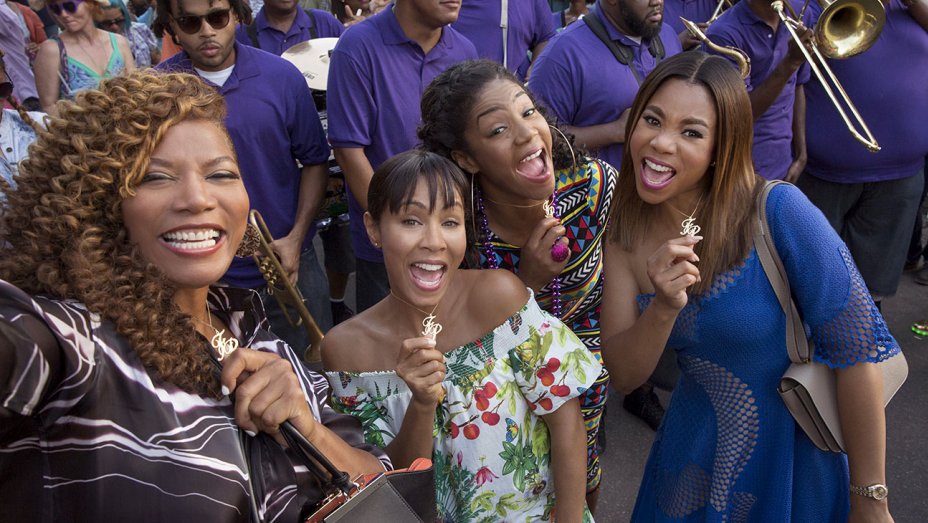
I'm gonna go out on a limb and say I'm probably not the target audience for Girls Trip, but looks can be deceiving. Truth be told, I don't mind a good chick flick- emphasis on the "good" part.
I wasn't one of those guys that blew a gasket when they decided to do an all-female Ghostbusters reboot- I just wish it'd been a better, funnier movie. But sub-par though it may have been, my childhood remains intact, thank you very much. Anyone who says differently really needs to check their priorities- if not their privilege.

Likewise, I was really looking forward to Rough Night. I'm a long-time Scarlett Johansson fan, and always thought she was great on SNL- plus the rest of the cast, not unlike Ghostbusters, was made up of ace comedic performers, including Kate McKinnon, Illana Glazer (I freaking ADORE Broad City) and Jillian Bell (Workaholics).
Unfortunately, the film ended up being a lukewarm female take on Very Bad Things. As a direct result, I opted to skip Girls Trip, because what were the chances it wasn't just as bad? Shows what I know. Sometimes it takes a new angle to disrupt the balance of things.

In this case, it was a quartet of African-American actresses, led (and grounded by) by Regina Hall, who I always enjoyed in her over-the-top turns in the Scary Movie franchise. Interesting how the one who seemed the craziest in the past is now the glue holding this one together- the times they are a'changing, indeed.
Hall plays a would-be Oprah type, Ryan Pierce, looking to land a TV-chat-fest with her hunky husband, Stewart (Mike Colter, aka Luke Cage), as a sort of couple variation on one of those self-help shows that are so popular right now.

Unfortunately for her, her man is a cheater, and the news breaks right before they're getting ready to sign a huge deal. Can she keep a lid on it until the papers are signed? Maybe, thanks to old pal, Sasha (Queen Latifah), who runs a gossip blog, and is the one who first gets a heads-up about the news. But should Ryan even bother?
Ryan finds out about the slight from Sasha just as she arrives in New Orleans, where she's meeting up with old friends to attend the Essence Festival, including near-shut-in-and-stay-at-home-mom Lisa (Jada Pinkett Smith, Gotham) and wild child party girl Dina (scene-stealer comedian Tiffany Haddish).

Determined to have a good time and not let the revelation get her down, she and the girls take to the streets to party down, getting into a wide variety of nutty situations, which are actually pretty funny, more often than not.
Along the way, they eventually have a falling out, over Ryan's decision to give her husband the benefit of the doubt and give him a second chance, but more because of the show than any real feelings she has for him, which doesn't go over well with her friends.
To make matters worse, her hubby's cheatee, Simone (Deborah Ayorinde, also of Luke Cage) shows up at the festival to wreak havoc, threatening to blow the lid off their affair herself, in order to further her own career. This also causes quite a bit of strife with Ryan's posse. Shenanigans ensue.
I watched this on a free HBO preview, figuring it was no big loss if it sucked because I literally had nothing to lose, save time wasted, if it did. Knowing that it was one of those comedies that runs over two hours- too long comedies are a pet peeve of mine- I didn't expect much, despite knowing it was a huge box office hit and seemed to have gotten solid enough reviews from critics.
Well, as I learned from previous experience- see also my review of 22 Jump Street, which I recently posted- you never know sometimes. I was aware of Tiffany Haddish, certainly, not living under a rock. I'd seen the bulk of her largely autobiographical stand-up special She Ready!, as well as her fairly amusing turn in Key & Peele's movie Keanu, but I wasn't aware until fairly recently that she'd been plugging away at fame since the early mid-2000's.
Haddish is undeniably the break-out star here, and her enthusiasm is infectious. I can only imagine how well this played to female audiences in the the theaters, but I was admittedly in near-hysterics at times, and I can be a tough laugh sometimes. Here, I actually woke up my roommate, who got up to see what the hell was so funny.
Haddish really goes for broke here, and is gloriously filthy. (Wait till you see the "grapefruit" scene!) It's safe to say her sense of humor won't be for everyone, but from what I've seen of her on talk shows and her recent hosting gig on SNL, she's being pretty true to herself, in terms of how her actual persona lines up to the one here.
By contrast, her turn in Keanu and especially on the new TV show The Last O.G. are much more subdued, showing the girl has range. As such, she's definitely worth checking out in general, but especially here, where she is off-the-charts funny. You haven't lived until you see that zip-line scene, lol.

I also dug how each of the girls brought their own thing to the table, each getting their own laughs their own way. Hall, formerly the crazy one in the Scary Movie series, reigns things way in for this one, but manages to mine some solid laughs as someone tightly-wound, especially in her scenes with the invaluable Kate Walsh (Grey's Anatomy) as her would-be-down manager.

Walsh does her fair share of scene-stealing her own damn self, as she tries her best to be "down" with the main girls. A lot of African-American-heavy films would reduce a character like this to a token "white girl" thing (as in, "Isn't that funny, a white girl trying to be "street"?"), but Girls Trip actually gives Walsh a chance to get laughs and sympathy, as she tries her best to help Ryan navigate these thorny waters.
Indeed, that's sort of the key to why this film works. By juxtaposing laughs with heart, and generating pathos by virtue of the set-up, it all works like gangbusters. You feel for Ryan, who, after all, is being cheated on, just as she was about to get her big break.

Meanwhile, you also feel for the other girls, with Sasha working below her station as a gossip columnist when she used to want to be a serious reporter- something she was supposed to do via a website with Ryan, who abandoned her along the way for her own career.
Lisa was supposedly the "freaky" one, but now has settled into a boring single mom lifestyle who can't remember when she last when on a date. And Dina is her own worst enemy, getting the girls tossed out of their swanky hotel before they're fully even checked in, and starting trouble wherever she goes, almost unable to help herself.

In short, you care about these girls because their characters are well-defined and the scenario is so laden with drama, which makes the release of the laughs hit all the more harder. It actually manages to justify the lengthy running time, as a direct result. Sure, they could have pared down, say, some of the musical performance sequences, but all in all, it earns the length, I'd say.
So, there you go. I'm sure I'm preaching to the choir to some people by now, but for those who were dubious this wouldn't be their cup of tea, give it a shot- you might be surprised. It's got laughs and heart, and for my money, puts a lot of the other female-fronted ensemble would-be comedies I've seen over the last few years to shame. Check it out! 😃😜
Writer's Note: In honor of the talented-if-divisive auteur Wes Anderson's birthday, here's a look back at his interesting throwback film, The Grand Budapest Hotel. This article was originally published in UAB's Kaleidoscope on April 12th, 2014.
There are certain directors, commonly known as auteurs, who inhabit a certain rarefied place in the world of film, in that they are commonly held in higher regard than others, particularly by critics. If your name is often used as an adjective in describing a film, you’re in the club. Think Hitchcock, Kubrick, Lynch, Tarantino, Spielberg, et al.
Basically, if you’re watching a film by any of these directors, you know it’s them within minutes- or at the very least, if someone’s consciously aiming to emulate their style. Wes Anderson is certainly one of those directors, and his style is very much uniquely his own.
His movies play like adaptations of books that don’t actually exist, down to his frequent use of “chapter” motifs and narration, and a large, sweeping cast of characters and featured locales. Anderson’s films are very stylized and very specific, and if you don’t like that style, then you’re probably not going to like any of his films.
Granted, it often takes a little time to establish that style. Even Hitchcock didn’t start out as the Hitchcock we all know and many revere. In Anderson’s case, that style began as a sort of hipster indie sensibility, with the cult flick Bottle Rocket, then gained critical acclaim and mass acceptance with the still charming Rushmore.
Some prefer his early work, but to me, he didn’t really establish his particular style until his third film, The Royal Tenenbaums, which would prove to be the blueprint his films would follow from then on.
Other similarly-styled films followed, including the somewhat underrated The Life Aquatic with Steve Zissou, the loopy The Darjeeling Limited, and the oddball left-turn into stop-motion animation The Fantastic Mr. Fox.
With the fantastic Moonrise Kingdom, Anderson finally seemed to find a way to make a film that was true to his style and yet still affecting to audiences in a way many of his previous efforts were not.
When you have a certain type of style and it’s very affected and specific, it can often leave people cold, and Kingdom managed to find a way to rectify Anderson’s style with substance and genuine heart in a way that evades much of his other work.
With The Grand Budapest Hotel, Anderson backpedals ever so slightly, sacrificing some of that heart in the process, but delivering a winner, nonetheless. Hotel functions a sort of a tribute to a very specific type of film, a combination of a sweeping, decades-spanning epic and an old-school silent film, down to the boxy film ratio the film adopts for most of its running time (think old-school TV before it went letterbox format), and various techniques used back then, such as a circular deep focus, frequent wide-angle shots, intentionally and obviously sped-up effects and the extensive use of what are clearly model sets.

If all of this sounds like full-on film geek stuff, well, rest assured, it totally is. As such, as per usual with Anderson’s work, some people are going to hate it. But those who love it are really going to love it, and I mean really love it- as in they will be watching and re-watching this thing over & over again for years to come and studying its near-pathological attention to detail and the way each frame looks like it could be a still life painting, and I do mean every frame. It’s just that meticulous. Needless to say, obsessive-compulsives are going to adore it. This one certainly did.

The plot, such as it is, revolves around the history of a once-majestic hotel that has since fallen into semi-ruin. A “young writer” (no, really, that’s the character’s name), played by Jude Law, checks into said hotel and meets one Mr. Moustafa (F. Murray Abraham), who then proceeds to tell him the history of the hotel in detail, which we then see in flashback form.
Mustafa, aka Zero (Tony Revolori) is a young “lobby boy,” working under the tutelage of the legendary concierge Gustave H. (Ralph Fiennes), a not-exactly on the up-and-up chap who he then gets into a series of misadventures with. That’s about it.
Of course, the plot’s almost beside the point. You don’t go to Anderson’s movies for compelling plots- you go for the journey, not the destination. And what a journey it is. There are scenes in this movie that are as riveting, entertaining and compelling as anything I’ve ever seen in any movie, ever.
But did I necessarily care about the characters, per se? Not particularly. Yes, I liked them. Yes, I was fascinated, sometimes charmed by them. But did I care? Not so much. It’s not that kind of movie. None of Anderson’s work is that, really, which is exactly why a lot of people hate it.
And I get that, really I do. But I also get why people line up to work with the guy. Check out this cast: Adrien Brody, Tilda Swinton, Harvey Keitel, Bill Murray, Jeff Goldblum, Willem Dafoe, Saoirse Ronan, Edward Norton, the list goes on…
None of them have particularly big or even particularly memorable roles that will rank amongst their finest (though Dafoe perhaps comes closest to the mark, with his villainous turn). And yet, they make their mark, often in a mere scene or two.
That’s because Anderson gets that half the battle in a movie like this is casting, and casting well. You might not remember the crazy names he gives said characters, but you know the actors, and that’s why it works.

The other half is staging. Anderson’s films don’t work the way most people’s do. They unspool, unfold, reveal themselves as the film goes on. Not in a last act final twist sort of way (i.e. M. Night Shyamalan), or in a final scene that pulls it all together at the end sort of way (i.e. Christopher Nolan). More like a way in which you realize the details have been there all along, you just needed to hear the rest of the story to fill in the blanks.
You get more information by simply looking at a given frame of an Anderson movie than you probably do reading the script. It’s all there, you simply have to get the whole storytelling thing out of the way first, then you can get to the real movie hiding (but not truly) underneath the surface of the plot at hand.

That’s also why his movies hold up so well to further re-watching. Once you get the gist of things, you can just go back and simply enjoy them, passively, without worrying so much about what’s going to happen next, or how it all ends.
That, to me, is a wonderful quality for a movie to have. I mean, isn’t that what you want, a movie you can watch over & over again, learning something new every time?
Granted, it helps if you care about the characters, but if Anderson’s characters aren’t exactly the warm & fuzzy type, they’re nothing if not intriguing, so there’s that.
In fact, if he can just crack the code of how to reconcile his particular style with characters that are approachable and inviting, he might just really have something we can all enjoy. Until then, there’s The Grand Budapest Hotel, and it gets an A+ in my book.